
Introduction
The phrase “AI phone screening” tends to bring up the wrong picture. Most people imagine a robotic voice reading questions off a script, waiting through awkward pauses, and struggling the moment a candidate says something unexpected. That is not what happens inside Excruit. The AI phone screen is a real, live conversation, and understanding how it actually works explains why it changes hiring outcomes rather than just automating a task.
It Starts With a Real Conversation, Not a Script
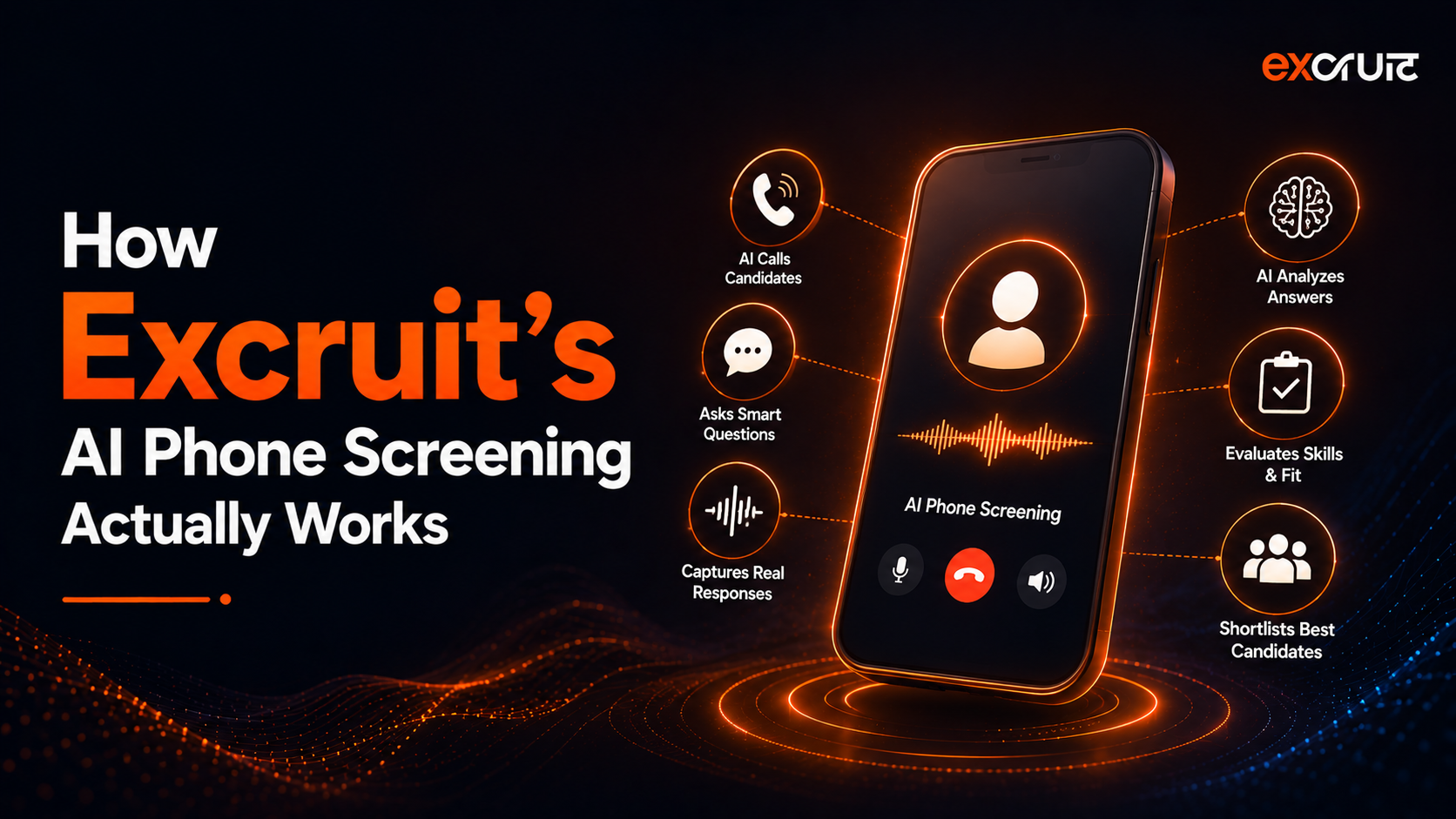
When a candidate responds to outreach, Excruit initiates a live phone call rather than sending them into an automated menu. The AI conducts the conversation with sub 800 millisecond latency, which is close enough to natural speech that candidates respond the way they would to a human recruiter, not to a machine reading questions at them. It listens, follows up on what the candidate actually says, and adjusts the conversation in real time instead of moving through a fixed list regardless of the answer.
This matters more than it sounds. Traditional phone screens live or die on scheduling. A candidate has to be available at the exact time a recruiter is free, which is a large part of why hiring drags out over weeks. Excruit’s AI phone screening removes that bottleneck entirely, engaging candidates the moment they respond, at whatever hour that happens to be.
Built on the Role Context Graph
Every AI phone screen is grounded in the Role Context Graph created when the job description was generated. This means the questions asked on the call are directly mapped to the skills and requirements of that specific role, not a generic set of interview questions reused across every opening. A screen for a senior product designer role and a screen for a backend engineer role are structured entirely differently, because the underlying skill requirements are different.
Multilingual by Design
Excruit’s AI phone screening currently supports live conversation in English, Spanish, and Portuguese, which matters for any company sourcing candidates across multiple regions. The AI does not just translate a script, it conducts the actual screening conversation in the candidate’s language, which keeps the experience natural rather than mechanical.
Every Call Is Transcribed and Scored
As the call happens, Excruit transcribes the conversation and captures it as structured context that carries forward into the candidate’s profile. By the time a recruiter reviews the shortlist, the full context of that phone screen, not just a pass or fail marker, is attached and visible. This is a meaningful difference from traditional screening, where the substance of a phone call often lives only in a recruiter’s memory or a two line note.
Where It Fits in the Bigger Workflow
AI phone screening is step six in Excruit’s ten step hiring sequence, sitting right after outreach and right before the AI interview stage. Candidates who respond to outreach move into the phone screen automatically, and those who clear it move forward into a structured AI interview in voice, video, or text. Nothing sits waiting on a recruiter’s calendar in between.
Why This Changes the Numbers
Because the phone screen runs the moment a candidate is ready rather than the moment a recruiter has an open slot, the entire hiring timeline compresses. This is a large part of why time to fill a role drops from 45 to 60 days down to 15 to 25 days, and why candidate drop off, usually driven by scheduling delays and slow follow up, falls below 20 percent instead of the industry average of 65 to 70 percent.
Fair to Candidates, Not Just Efficient for Recruiters
Speed only matters if the process stays fair, which is why every candidate who goes through an Excruit AI interview receives a Right to Explanation report, giving them visibility into how they were assessed rather than a silent rejection. AI phone screening is not built to filter people out quietly. It is built to move qualified candidates forward faster than a manual process ever could.
Curious what an actual AI phone screen sounds like on a real role? Book a demo and listen to the workflow run end to end.