Introduction
A recruiter opens the applicant tracking system on a Monday morning and finds four hundred applications against one open role. The deadline for a first shortlist is Wednesday. Reading every resume line by line is not possible in that window, and skimming risks missing a strong candidate buried on page six. This is the situation that has pushed AI candidate screening from a niche experiment into a standard part of the recruiter’s toolkit.
AI candidate screening is the use of artificial intelligence to analyze applicant information, such as resumes, screening responses, and assessment results, against a role’s requirements, so recruiters can identify which candidates are worth reviewing first. It is not a replacement for recruiter judgment. It narrows a large pool into a manageable, better-informed shortlist, with the final hiring decision still resting with people.
What Is AI Candidate Screening?
At its core, AI candidate screening applies machine learning and natural language processing to applicant data so that recruiters spend less time sorting through unqualified applications and more time engaging with candidates who fit.
Modern AI screening tools can analyze a range of inputs, including:
- Skills listed or demonstrated in a resume
- Work experience and job history
- Education and certifications
- Projects and portfolio evidence
- Responses to predefined screening questions
- Results from skills or competency assessments
This is meaningfully different from keyword filtering, which most traditional applicant tracking systems still rely on. Keyword filtering looks for exact or near-exact matches between a job description and a resume. If a candidate describes their experience with different terminology, a keyword filter can miss them entirely, even when the underlying skill is present.
AI-based screening, by contrast, can use semantic understanding to recognize relationships between skills and experience rather than relying solely on exact wording. That said, no system understands a resume with full human context. A resume is an incomplete record of any candidate’s actual capability. Recruiters should treat AI screening as a strong filter, not an infallible judge.
How Does AI Candidate Screening Work?
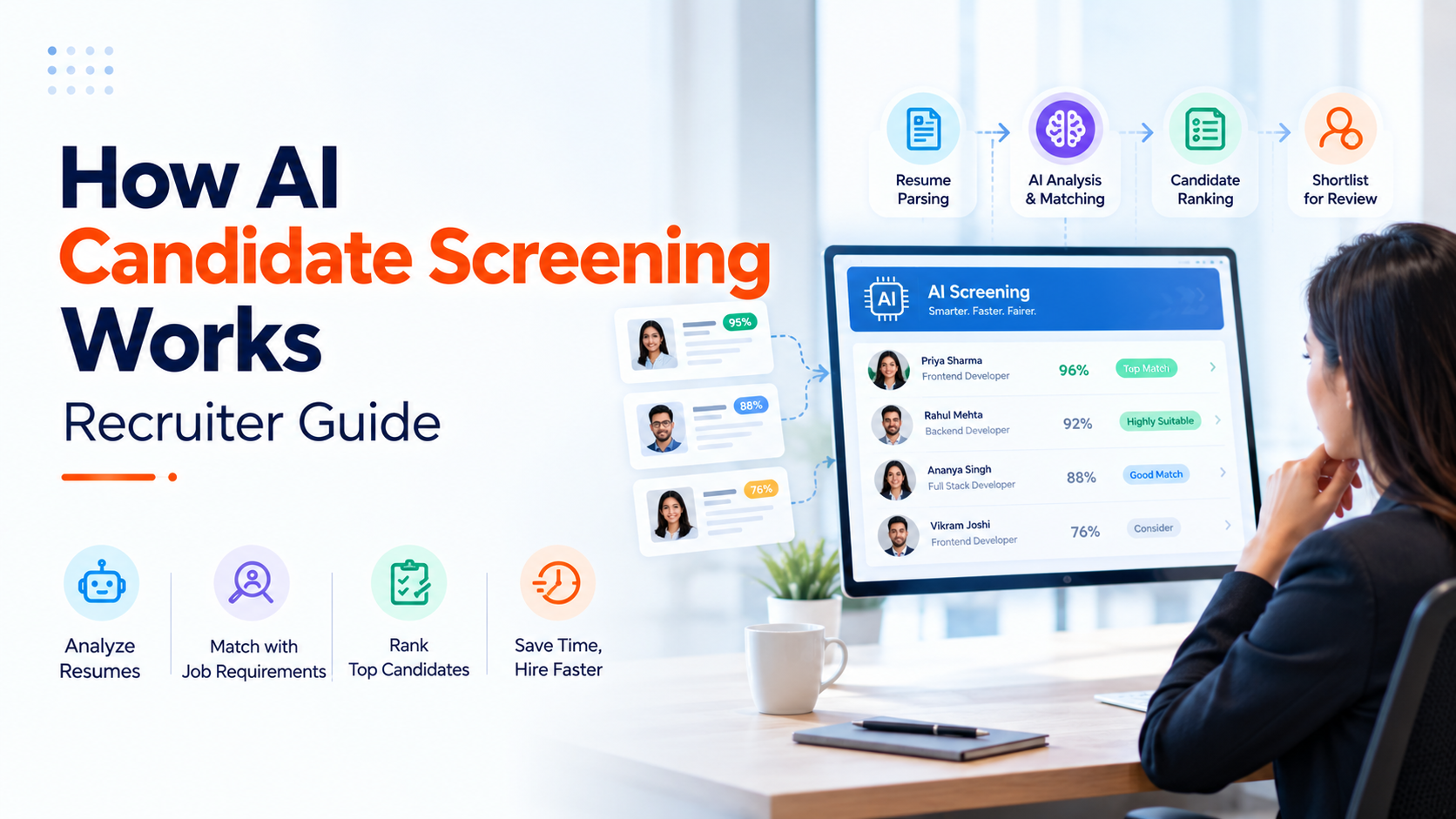
The screening process generally follows six stages, from job requirements to a human hiring decision.
Step 1: Define the Job Requirements
Everything starts with the job description and the hiring criteria behind it: required skills, preferred skills, years of experience, education, certifications, location, and availability. A vague or bloated job description, one that lists twenty “nice to have” skills as if they were mandatory, produces poor screening outcomes no matter how good the underlying AI is. The quality of the input criteria sets a ceiling on the quality of the output shortlist.
Step 2: Collect and Parse Candidate Information
Once applications arrive, the system parses resumes, CVs, application form answers, and any screening question responses into structured data. Resume parsing simply means extracting information such as job titles, dates, skills, and education from an unstructured document and organizing it into fields the system can compare against the job requirements.
Step 3: Understand Skills and Experience
This is where semantic matching comes in. A candidate might describe experience as “led a cross-functional product launch” while the job description asks for “project management experience.” A keyword match would miss the connection; semantic matching looks at the relationship between the job requirement, the candidate’s stated skills, and any supporting evidence. It is an improvement over exact-match filtering, but it is not the same as a human reader inferring context or nuance from a resume.
Step 4: Score and Rank Candidates
Candidates are then evaluated against the defined criteria, factoring in elements like skills match, relevant experience, seniority, assessment performance, and screening answers. Different platforms use different scoring methodologies, and a score from one tool is not directly comparable to a score from another. A match score should be read as a starting signal, not an objective measure of a candidate’s worth.
Step 5: Generate a Shortlist or Recommendation
Recruiters typically receive a ranked list along with match scores, candidate summaries, and a breakdown of matched and missing requirements. The useful part of this stage is not the score itself but the evidence behind it. A recruiter who looks only at the number and skips the underlying detail is trusting the system more than it is designed to be trusted.
Step 6: Human Review and the Next Hiring Stage
AI narrows the pool. People make the decision. The workflow, in practice, looks like this: AI screening leads to recruiter review, which leads to interview or assessment, which leads to final evaluation and a hiring decision. Skipping the recruiter review step is where AI screening tends to go wrong.
What Does AI Look for When Screening Candidates?
| Screening Factor | What AI May Evaluate |
| Skills | Required and relevant technical or functional skills |
| Experience | Years, relevance, and depth of experience |
| Education | Degree or education requirements where applicable |
| Certifications | Role-specific qualifications |
| Projects | Evidence of practical, hands-on experience |
| Screening Answers | Responses to predefined questions |
| Assessments | Results from skills or competency tests |
AI screening should evaluate job-relevant information. It should not factor in protected characteristics or details unrelated to a candidate’s ability to do the job, and recruiters should confirm this is true of any tool before relying on it.
AI Candidate Screening vs Traditional Resume Screening
| Factor | Manual Screening | Traditional ATS Filtering | AI Candidate Screening |
| Resume review | Human | Rule or keyword based | AI-assisted |
| Speed | Slow at high volume | Faster | Fast |
| Context understanding | High but time-consuming | Limited | Broader semantic analysis, still imperfect |
| Candidate ranking | Manual | Basic filtering | Scoring and recommendations |
| Scalability | Limited | High | High |
| Human involvement | High | Medium | Should remain significant |
These categories overlap in practice. Most AI candidate screening tools sit on top of, or alongside, an existing ATS rather than replacing it outright.
Benefits of AI Candidate Screening for Recruiters
Faster candidate shortlisting. AI handles the repetitive first pass, freeing recruiters to focus on candidates who have already cleared a baseline filter.
Handles high application volumes. For roles that draw hundreds of applicants, this is often the difference between a shortlist by Wednesday and one two weeks late.
More consistent screening criteria. Applied correctly, AI evaluates every application against the same criteria, reducing the inconsistency that creeps into manual review by application four hundred.
Recruiter productivity. Less time reviewing every application means more time talking to qualified candidates.
Skills-based hiring. AI screening can support evaluation based on demonstrated skills rather than job titles or resume formatting alone, helping surface non-traditional candidates.
Better workflow visibility. Structured screening data gives recruiters a clearer picture of why candidates advanced or did not, useful for refining criteria over time.
None of this guarantees better hiring quality on its own. The outcome depends on how well the criteria were defined and how the recommendations are used.
Can AI Candidate Screening Reduce Hiring Bias?
Sometimes, but not automatically. AI can reduce certain forms of inconsistency, such as a recruiter applying different standards to similar candidates on different days. It does not eliminate bias by default, and in some cases it can introduce new forms of it.
Common risk factors include biased training data, poorly designed screening criteria, proxy variables that correlate with protected characteristics without naming them directly, overreliance on historical hiring patterns, and a general lack of transparency into how a score was generated.
Responsible practice generally includes using job-relevant criteria only, auditing screening outcomes regularly, testing models rather than assuming they stay accurate, maintaining human oversight at decision points, monitoring for disparate outcomes across candidate groups, and avoiding unnecessary personal data in the screening process. Industry discussion, from bodies like SHRM and researchers studying algorithmic hiring, increasingly centers on auditability, fairness, privacy, and human oversight as baseline expectations for responsible AI recruitment. This is general practice, not legal advice, and organizations should involve legal and compliance counsel when setting AI screening policy.
What Are the Limitations of AI Candidate Screening?
AI can misunderstand context. A resume is a partial, self-reported record that does not capture everything about a candidate’s actual capability.
AI can inherit bias. Models and the data behind them can carry historical patterns forward, including patterns worth breaking.
False positives and negatives happen. A strong candidate can score low due to an unconventional resume format, while a weaker candidate can score well by matching the right keywords.
Resume quality is not candidate quality. A polished, well-formatted resume should not be treated as a proxy for a stronger candidate.
Candidate experience matters. Over-automating the early stages of hiring can make the process feel impersonal.
AI should not make high-stakes decisions alone. Screening is a filtering step, not a hiring decision, and should never be the final word on a candidate.
How Recruiters Can Use AI Candidate Screening Effectively
- Start with clear, well-scoped job requirements
- Separate must-have skills from nice-to-have skills
- Use structured, consistent screening criteria
- Avoid unnecessary or inflated requirements
- Review AI recommendations rather than accepting scores blindly
- Audit candidate outcomes on a regular schedule
- Watch for patterns in false positives and false negatives
- Keep human recruiters involved at every meaningful decision point
- Protect candidate data and be transparent about how it is used
- Measure actual hiring outcomes, not just screening speed
Where Does AI Fit Into the Modern Recruitment Process?
A typical modern hiring workflow now looks something like this: job description, candidate sourcing, application, AI screening, assessment or interview, recruiter review, final interview, and hiring decision. AI candidate screening is one part of a larger recruitment technology stack, not a standalone solution. Newer AI recruitment platforms are increasingly built to connect several of these stages together, rather than functioning only as a resume filter sitting in front of an otherwise disconnected process.
How Excruit Can Support AI-Powered Recruitment
For organizations looking to move beyond manual screening, platforms such as Excruit illustrate how AI can become part of a broader recruitment workflow rather than a single isolated tool. Excruit’s AI talent intelligence capability centers on resume analysis, candidate ranking, and skills-based evaluation, sitting alongside job distribution, AI-assisted interviews, and a connected applicant tracking and CRM workspace.
The practical value is less about any single feature and more about reducing repetitive manual work at the top of the funnel, so recruiter time goes toward candidates who have already been evaluated against defined, job-relevant criteria. If your team is weighing how AI screening fits into your existing workflow, it is worth exploring how a connected platform like Excruit handles that first stage before candidates reach a recruiter’s desk.
What Should Recruiters Look for in an AI Candidate Screening Tool?
- Screening accuracy against real hiring outcomes, not just marketing claims
- Explainable recommendations, not just a black-box score
- Skills-based matching rather than pure keyword matching
- Integration with your existing ATS
- A screening experience that respects candidates’ time
- Documented bias monitoring practices
- Clear data privacy and retention policies
- Human review controls at key decision points
- Support for custom, role-specific screening criteria
- Reporting and analytics on screening outcomes
- Scalability for your actual hiring volume
- A realistic implementation timeline for your team
The right answer depends on your organization’s hiring volume, the types of roles you fill, your existing recruitment technology, and how much control your team needs over the screening criteria.
Conclusion
AI candidate screening helps recruiters process high application volumes without reading every resume line by line. It can analyze skills, experience, and other job-relevant information, improving both screening speed and consistency compared to manual review alone. It is not infallible, and it should never be the sole basis for a hiring decision. The best results come from pairing AI automation with structured recruitment practices and consistent human oversight, using AI to handle the repetitive first pass so recruiters can spend their time where it matters most: talking to the right candidates.
